The Feast
Alicja Rogalska, 2022
A toast to the Great Redistribution, from a dinner imagined after fossil fuels.
Peerticipatory Worldplay:Seizing the Means of Imagination
The Last Party imagines a network of fictional political parties whose programmes people write and enact together. This prologue explores shared fiction as a way to organise alternatives to capitalism, and the collective work needed to sustain them.
A lollipop appears in the ant group. Replies include “AVOID” and “LICK”.
Facebook group participants · VICE, 2020
Players meet online in We were made for this // 2050 Fugitive Planning, a role-playing experiment developed through The Hologram.
Cassie Thornton, Lita Wallis & collaborators
Alicja Rogalska’s The Feast (2022). Dinner guests look back on the end of dependence on fossil fuels.
Alicja Rogalska · The Feast, 2022
Participants carry species placards through the Interspecies Festival of Finsbury Park, 2023.
Photograph: Furtherfield
Julia Sachs (2020). “Amid Shelter In Place Orders, Facebook Groups Are Getting Very, Very Creative.” Grit Daily, 17 April.
Crystal Chen (2020). “A critical look at ‘Pretend to be…’ Facebook groups.” The Stanford Daily, 25 May.
William Davies, ed. (2018). Economic Science Fictions. Goldsmiths Press.
See Davies’s introduction, pp. 22–24.
J. K. Gibson-Graham (2008). “Diverse Economies: Performative Practices for ‘Other Worlds’.” Progress in Human Geography 32 (5), 613–632.
Cassie Thornton, Lita Wallis and collaborators (2021). The Hologram: 2050 Fugitive Planning.
The role-playing experiment grew from The Hologram’s peer care practice.
Maja Kuzmanovic and Nik Gaffney (2017). “Enacting Futures in Postnormal Times.” Futures 86, 107–117.
Alicja Rogalska (2022). The Feast. Film.
A future dinner commemorating the end of reliance on fossil fuels.
Furtherfield. The Treaty of Finsbury Park 2025.
Interspecies assemblies, play and collective commitments to biodiversity.
Furtherfield (2021). Biodiversity Habitats in Finsbury Park: The Interspecies Assembly.
Recording of the online assembly for IAM Weekend.
Stuart Candy (2010). The Futures of Everyday Life: Politics and the Design of Experiential Scenarios. PhD dissertation, University of Hawai‘i at Mānoa.
See pp. 118–130 and 220–254.
Max Haiven and Alex Khasnabish (2014). The Radical Imagination: Social Movement Research in the Age of Austerity. Zed Books.
Alicja Rogalska (2026). Rerouting. Film, 38 minutes. Galerie Nord, Counterplay exhibition booklet, pp. 4 and 7.
Bicycle couriers in Berlin use a fictional game to develop alternatives grounded in their working lives.
Centrala. “I-CLAIM: Alicja Rogalska – Rerouting.”
The collaboration and its proposals for cooperative logistics and collective ownership.
Zsu Zsuró and Alicja Rogalska (2023). “In Conversation With… Alicja Rogalska.” MMpraxis, July.
On collective speculation, live-action role-playing and improvised dialogue.
Alicja Rogalska, 2022
A toast to the Great Redistribution, from a dinner imagined after fossil fuels.
Colonnades, 2025
Park air and birds beneath the opening and the return from The Feast.
·CC0.
Music from Bioerosion, by Lim Giong
plants breaking through concreteA historical SCP Wiki homepage presents the shared fiction as the records of a secret foundation.
SCP Wiki contributors
Witness’s floating districts share connections while following different economic arrangements.
Illustration: Michela De Domenico
SCP Wiki. “Licensing Guide.”
Edgeryders (2021). “Quick guide: engage with the creation of Witness.”
Christopher M. Kelty (2008). Two Bits: The Cultural Significance of Free Software. Duke University Press.
Sasha Costanza-Chock (2020). Design Justice: Community-Led Practices to Build the Worlds We Need. MIT Press.
See chapter 2.
TheVolgun; story by llama66613, 2018
A reading from the SCP Foundation’s shared fiction.
A brief typing sound at the chapter heading.
Music from Bioerosion, by Lim Giong
underground water pipe ·The New York Times Special Edition imagined an end to the Iraq War. Distributed in November 2008 and dated July 2009, it came with a leaflet for volunteers.
Steve Lambert, the Yes Men & collaborators
A contribution to an Imagining organised through the U.S. Department of Arts and Culture.
U.S. Department of Arts and Culture
Steve Lambert (2008). “The New York Times Special Edition.”
The Yes Men and collaborators (2008). New York Times special edition, dated 4 July 2009.
The complete fourteen-page edition, distributed in November 2008.
The Yes Men. “The story of the (fake) end of the Iraq War.”
A retrospective on the newspaper action and the campaigns surrounding it.
U.S. Department of Arts and Culture. “Imaginings.”
Luke Yates (2015). “Rethinking Prefiguration: Alternatives, Micropolitics and Goals in Social Movements.” Social Movement Studies 14 (1), 1–21.
Paper being handled as the chapter begins.
Breviceps, 2018
A short paper gesture during the newspaper passage.
CC0.
Music from Bioerosion, by Lim Giong
hydraulicsThe Perception Dollar, issue 1 (2010). A banknote-shaped gift of images, ideas and links for exploring economic alternatives.
Carol Brouillet · Artwork: Blaine Machan & contributors
A participant sews a story label into a garment during Fashion Fictions’ World 27 enactment, linking clothing to a recorded story.
Fashion Fictions · Amy Twigger Holroyd
Pablo Somonte Ruano. pocas, “Origin & Intention” and “Protocolitos.”
Mutualist spaces and small voluntary agreements.
Carol Brouillet. “About the Perception Dollar.”
A banknote-shaped publication circulated as a gift.
Amy Twigger Holroyd. Parallel Presents.
Ways to compose and enact alternative worlds in everyday life.
SenseLab. “Anarchive – Concise Definition.”
Conversation and café sounds around the imagined encounter.
·Music from Bioerosion, by Lim Giong
plants breaking through concretePLANET’s proposed community start page, designed in 2004. Local news sits beside requests for help, skills exchange and offers of paid work.
Oli S-B · The Open Co-op
A 596 Acres map on a vacant-lot fence in Brooklyn. The map brings the question of public land to the site itself.
Photograph: Eric Fischer · 596 Acres
Adrien Labaeye (2017). “Collaboratively Mapping Alternative Economies: Co-producing Transformative Knowledge.” Netcom 31 (1/2), 99–128.
See pp. 113 and 117 on 596 Acres, and pp. 120–122 on mapping practices and infrastructure.
Michael Albert (2019). “Socialism: Who Does What?” ZNetwork, 17 April.
Balanced job complexes and participation in collective decisions.
A few clock ticks at the chapter heading.
Music from Bioerosion, by Lim Giong
liquid metalsteam engine · Lim Giong, Bioerosion
Theatre NO99’s Unified Estonia convention at Saku Suurhall, 7 May 2010. More than 7,200 people attended the performance of a political movement.
Photograph: Rainer Kurbel · Teater NO99
Jón Gnarr delivers his December 2010 Christmas address dressed as Darth Vader.
Besti Flokkurinn archive
Eva-Liisa Linder (2018). “How Theatre Develops Democracy: The Case of Theatre NO99.” Nordic Theatre Studies 25 (1), 84–96.
Dominic Boyer (2013). “Simply the Best: Parody and Political Sincerity in Iceland.” American Ethnologist 40 (2), 276–287.
Erik Swyngedouw (2009). “The Antinomies of the Postpolitical City: In Search of a Democratic Politics of Environmental Production.” International Journal of Urban and Regional Research 33 (3), 601–620.
See p. 614 on political fictions.
Tiit Ojasoo and Ene-Liis Semper, 2013
A brief news-report excerpt from Theatre NO99’s documentary about Unified Estonia.
Produced by Allfilm and NO99. Sound: Harmo Kallaste.
Original recording: 1:07:01.8–1:07:13.2.
“Everyone knows that!” A street-interview image reproduced in George Harry James’s essay on Italian brainrot.
Institute of Network Cultures · George Harry James
Through the Stridegate (2025), by The Archive In Between. Its first episode, Welcome to the Great Structure, invites listeners into a library between worlds.
The Archive In Between · 2025
George Harry James (2026). “Performing Belief, Making Meaning (the DARK TRUTH behind Italian Brainrot Lore).” Institute of Network Cultures, 25 April.
The Daily Egg (2025). “The Honest AI Artist.” Interview with the creator of The Archive In Between, 28 March.
FREAKBAiT. Today’s Mission, video series.
FREAKBAiT. Today’s Mission, book.
FREAKBAiT on the project’s Situationist and Discordian influences.
The Archive In Between (2025). “Behind the Scenes – Thus Came the Eenth.” 24 June.
On performance, imagery and voice transformation.
THE VOID+ (2026). We Have Always Been Brainrotted. Written by Lea Sande. Aksioma, developed with the Institute of Network Cultures.
The Archive In Between, 2025
An invitation to a library connecting different worlds.
Original recording: 00:27.2–01:26.4.
FREAKBAiT
A short mission asking listeners to bring a phrase into everyday conversation.
Original recording: 00:00.0–00:08.1.
Music from Bioerosion, by Lim Giong
liquid metal · ·Honey in the studio in Lizzie Borden’s Born in Flames (1983).
Lizzie Borden · Anthology Film Archives
Around the microphones and turntables at Radio Alice, Bologna.
Qui Radio Alice exhibition archive
Lizzie Borden (1983). Born in Flames. Film.
Alison Kozberg’s interview with Borden on making the film: “Stay Ready: Lizzie Borden on the Post-Revolutionary Future of Born in Flames”, Walker Art Center, 27 April 2016.
Damien Pollard (2024). “Radio Alice and Italy’s Movement of 1977: Polyvocality, Sonority and Space.” In Radio as Radical Education, edited by Grégoire Rousseau and Nora Sternfeld, 68–83. Station of Commons.
An earlier version of this chapter appeared as a journal article in 2021.
Radio Alice. Recordings from March 1977.
Library of Congress (2016). “Page from the Past: War of the Worlds.”
The Mercury Theatre on the Air’s 1938 broadcast and the history of its reception.
W. Joseph Campbell (2010). “War of the Worlds radio panic was overstated.”
Static introduces the chapter on political radio.
Lizzie Borden, 1983
Two excerpts from the film’s fictional radio broadcasts.
·Radio Alice; greeting voiced by Riccio
A recorded station greeting used between live programmes, with Gryphon’s “Opening Move”.
Recording preserved in the Radio Alice archive. Music in the original tape: Gryphon, “Opening Move”.
Original recording: 03:57.2–04:11.0.
Provide Infrastructures for Commoning, an illustration from Free, Fair and Alive (2019).
Illustration: Mercè M. Tarrés · 2019
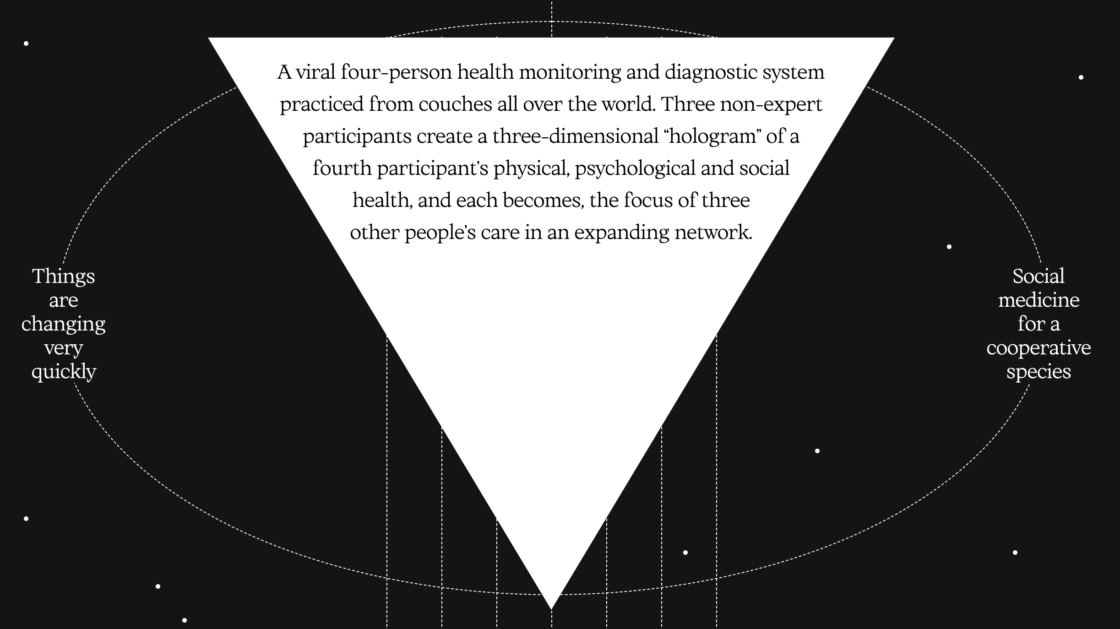
The Hologram connects a four-person care practice with an expanding network, as participants become part of further groups.
Cassie Thornton · The Hologram
Shu Lea Cheang, Armin Medosch and Yukiko Shikata, curators (2004). Game Commons at Game Scenes, Yerba Buena Center for the Arts, 17 January–4 April.
Kingdom of Piracy (2004). “Game Commons Online Platform: Call for Builders and Players.”
The call imagined “a contested playground for commons gaming”, with locally held game materials shared through an index of playing cards.
Internet Archive. “Using the Wayback Machine.”
Carol Dumaine (2010). “Common Security, Uncommon Challenges: Resiliency in an Era of the Unthinkable.” ParisTech Review.
Stuart Candy (2014). “Build Your Own Time Machine.”
David Bollier and Silke Helfrich (2019). Free, Fair, and Alive: The Insurgent Power of the Commons. New Society Publishers.
See chapters 4–6.
Laura Barendregt, Roy Bendor and Bregje F. van Eekelen (2024). “Public Participation in Futuring: A Systematic Literature Review.” Futures 158, 103346.
Silvia Federici (2010). “Feminism and the Politics of the Commons.” In Uses of a Whirlwind, edited by Team Colors Collective. AK Press.
From FORMER WEST (2016), republished by BAK.
Mark Fisher (2012). “Post-Capitalist Desire.” In What We Are Fighting For: A Radical Collective Manifesto, edited by Federico Campagna and Emanuele Campiglio, 131–138. Pluto Press.
adrienne maree brown (2019). Pleasure Activism: The Politics of Feeling Good. AK Press.
Audre Lorde (1978). “Uses of the Erotic: The Erotic as Power.”
Reprinted in brown’s Pleasure Activism (2019); excerpted in brown’s “The Pleasure Issue”, YES! Magazine, 18 May 2022.
adrienne maree brown (2022). “Pleasure Activism.” Boston Review, 11 October.
An excerpt from the 2019 book.
Rok returns to The Last Party and the possibility of others making broadcasts of their own. Pekko Koskinen considers the question mark at the end of the party’s name, and how people might find a direction together.
Pekko Koskinen
Music from Bioerosion, by Lim Giong
plants breaking through concrete ·The reading was adapted from an essay for ISSUES, the collective publication of School of Commons. It grew from Peerticipatory Worldplay, the project Rok Kranjc and Pablo Somonte Ruano developed together during their residency.
You’re welcome to take the reading and frame it as the first broadcast of your own Last Party. Keep the credits with it, so listeners can find the people and work behind it.
Where no licence is listed, consult the original source for reuse terms.
Composed by Lim Giong, conceptually developed by Lim Giong and Luca Bonaccorsi, released by the Open Culture Foundation in September 2024, licensed under Creative Commons Attribution 4.0 International.
Music excerpts are edited and mixed with the reading.